The air has the essence and allure of festive fervor during this time of the year.
From the sudden appearance of Halloween displays to the frantic countdown of Cyber Week and the final, breathless dash toward Christmas Eve, the final quarter entails millions swipe cards, unbox gadgets, and seek the comforting illusion of abundance amidst macroeconomic whispers.
It is a beautiful thing to watch and a brutal thing to operate.
For modern retailers and enterprise leaders, this glittering festive surge hides a formidable operational paradox. How do you deliver intimate, bespoke personalization when millions of shoppers descend upon your digital and physical channels simultaneously? How do you prevent your logistics, customer service, and order management frameworks from buckling under the sheer weight of seasonal ambition?
A customer may be one among millions to a retailer. But to that customer, the purchase is still personal. The challenge, then, is no longer simply personalisation.
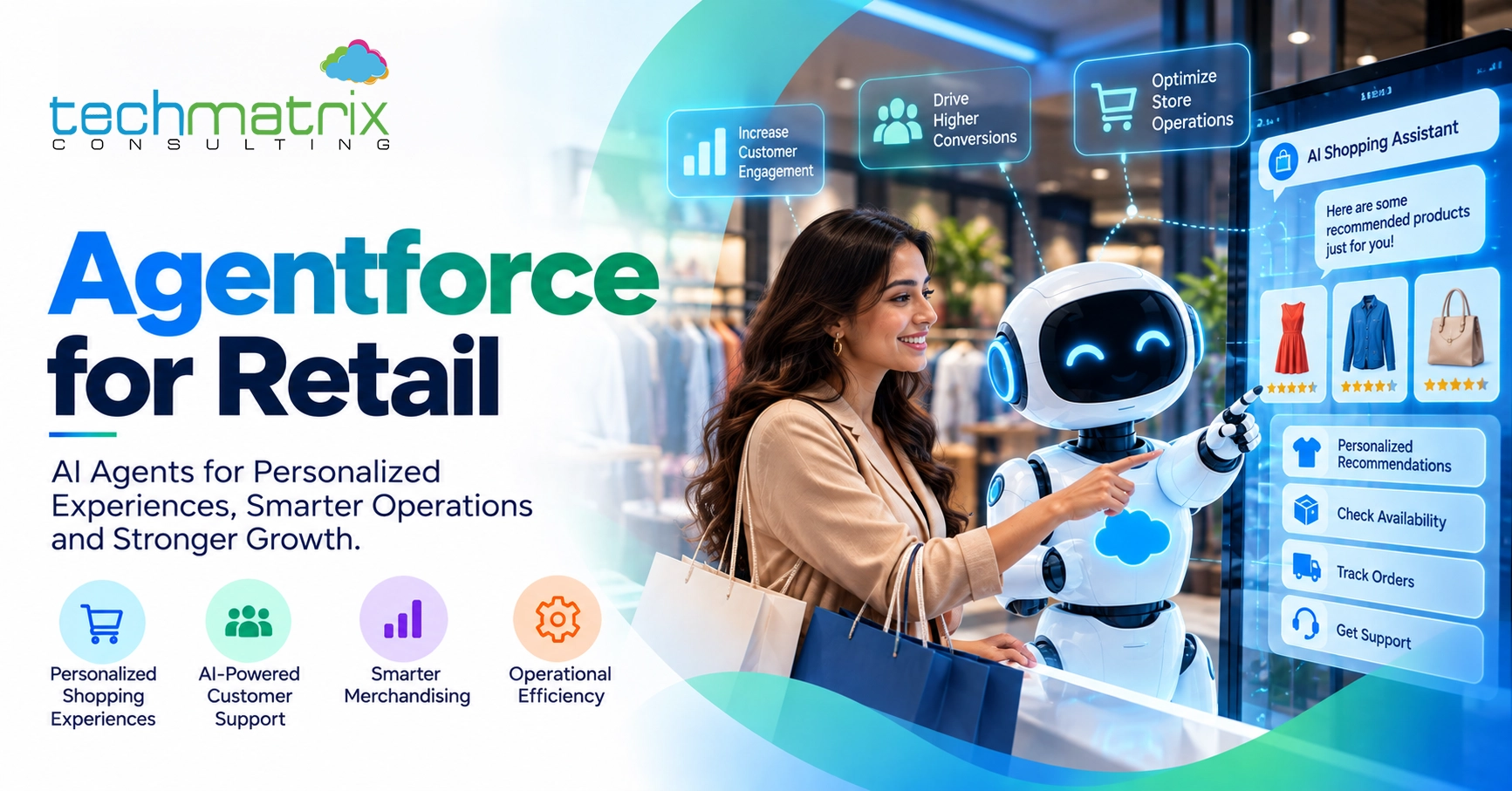
It is personalisation at the speed and scale of peak season. This is where Agentforce retail becomes particularly relevant. Not any friendlier chatbot on the product page, but an AI CRM with the authority to act. Agentforce is the AI agents retail layer that knows the customer, holds the order, watches the inventory, and is trusted to help business owners scale personalization while turning seasonal chaos into predictable, scalable revenue.
Why Traditional Systems Stumble During Peak Seasons?
Every holiday season exposes the structural friction of legacy retail systems. When millions of shoppers flood digital storefronts looking for everything from Halloween costumes to last-minute Christmas electronics, they expect an interactive dialogue, not a static catalog. They want instant clarity on shipping cutoffs, inventory availability across local stores, and tailored suggestions that reflect their actual intent.
Historically, scaling this level of personalization meant inflating labor overhead or drowning customer support teams in a sea of repetitive WISMO (“Where Is My Order?”) inquiries. This is where AI agents retail frameworks redefine the operational baseline. Unlike rigid chatbots that loop through frustrating pre-programmed scripts, autonomous AI agents retail operate with deep contextual awareness.
Powered by Salesforce Data Cloud, these digital teammates reason, make decisions, and act autonomously. When a shopper asks a complex question about product bundles, return windows, or cross-channel gift cards during the peak Black Friday rush, the AI doesn’t just pull a static database entry; it understands context, checks real-time inventory across warehouses, and delivers a curated, human-like response in milliseconds.
Why does the festive quarter particularly outgrow the business CRM systems that run it? Now, let’s study numbers.
Start with the size of the prize. Deloitte projects holiday retail sales of $1.70 to $1.71 trillion for November 2026 through January 2027, up 4.0% to 4.8%, with e-commerce growing 7.5% to 8.4% to somewhere near $317 billion. NRF has U.S. retail sales reaching $5.6 trillion in 2026. Halloween alone set a record at $13.1 billion and $114.45 a head last year, and NRF’s tracking shows a quarter of consumers had already bought at least one Halloween item by early August.
Now the number that should keep merchandising leaders up at night. Salesforce’s Shopping Index found global digital traffic up 18% year over year in Q2 2026, while order volume rose 1%. Cart abandonment sits at 82%.
Read that as a sentence rather than a statistic. It will show you how far more people are showing up, and almost none of the increase is converting. The traffic is real. The intent behind it has simply moved upstream, into conversations happening somewhere you don’t own, and what lands on your site is a shopper who has already made up their mind or already been talked out of you.
Layer on economics. Salesforce’s 2026 holiday forecast notes consumer pessimism up 16% over last year, with 13% more shoppers reporting their finances are getting worse, producing what it calls a K-shaped season: premium bundling at the top, ruthless value-seeking at the bottom, and a vanishing “average customer” in the middle that most personalisation engines were quietly built to serve.
A wider calendar, flatter conversion, and two customers where there used to be one. You cannot staff your way out of that. Seasonal hiring gives you hands, but this problem needs memory.
Then, you need contextual memory CRM systems that can handle personalization. Why?
Online ecommerce is growing at a staggering scale, while the expectation of personal attention continues to shrink.
Somewhere between the first scroll and the final checkout, retail shopping has picked up a new ritual: the refresh button.
Customers tend to follow a familiar loop – search, compare, add to cart, check the delivery date, abandon, return, reconsider, buy.
Why? Because people rarely think in product categories anymore. They think in situations.
- “I need a gift for my brother who just moved into a new apartment.”
- “I need a winter coat that works for commuting but doesn’t look like hiking gear.”
- “I need a toy for a six-year-old who is obsessed with space.”
- “I need something under $150 that can arrive before Christmas.”
These are not keyword queries. They are small pieces of context.
This is where AI agents in retail can step in, turning that context into an actual shopping conversation.
Salesforce’s latest Agentforce ecommerce capabilities include a Shopper Agent that draws on catalog, inventory, and customer context to guide a shopper from discovery through checkout and into post-purchase service. Its newer Agentic Commerce Search is built to interpret intent rather than simply match keywords.
That distinction matters.
A conventional search engine asks, “Which products match these words?”
An intelligent shopping experience asks, “What is this person actually trying to accomplish?”
The second question is much closer to how a skilled store associate thinks.
That is precisely the experience retailers are trying to recreate with Agentforce ecommerce, without needing a salesperson behind every browser window.
Agentforce ecommerce for 2026, because the sale doesn’t end at checkout
Retailers have traditionally treated the checkout button as the finish line. In reality, the customer journey begins there. After checkout come the questions.
- “Where is my order?”
- “Can I change the delivery address?”
- “Can I exchange this for another size?”
- “Can I return this gift?”
- “Can I reorder something I bought last year?”
During the holiday season, these are not edge cases. They are the second wave of commerce.
Salesforce reported that during Cyber Week 2025, its Order Management System handled 76% more orders, while Agentforce Service helped resolve more than 4.2 billion case interactions across the same period.
This is where Agentforce ecommerce shifts from making shopping feel clever to making the entire operation genuinely responsive.
An agent grounded in customer, order, and inventory data can help customers track shipments, answer product questions, support returns, and surface relevant next steps.
The customer sees a conversation. Behind it sits an interconnected system of commerce, CRM, inventory, service, and fulfillment.
That distinction is important.
Personalization without operational intelligence is theater.
The sale may have happened days ago, but the customer experience is still being shaped. That makes order management and service inseparable from personalization.
A genuinely intelligent retail agent should not hand a customer from one disconnected system to another. It should understand the full journey. The same customer who received a personalized product recommendation should not become an anonymous order number the moment payment clears. The relationship should survive the transaction. That is exactly what Agentforce ecommerce is designed to deliver.
The real promise of AI in retail is not more automation. It is more attention.
The holiday season will keep getting louder in 2026. There will always be another sale and another return. There is a temptation to describe AI agents retail in terms of what they replace. The better question is what they make possible.
Infographic:
Agentforce retail absorbs some of the repetitive complexity:
- A customer service team that no longer spends its peak-season hours answering routine order-status questions can focus on complex cases.
- A merchandiser can spend less time digging through product information and more time understanding demand.
- A marketer can move beyond broad segments towards conversations shaped by actual customer context.
- A shopper can receive assistance without waiting for a store associate to become available.
Agentforce retail is not a chatbot, but a connected intelligence layer wearing a Santa hat!
Not another AI layer pasted onto an existing storefront.
But a connected intelligence layer that can understand what the shopper wants, draw on the context the business already has, act across commerce and service workflows, and continue the conversation after the transaction.
The holiday season compresses all of retail contradictions into a few short months.
- More customers, but less patience.
- More products, but more choice.
- More channels, but less tolerance for fragmented experiences.
- More data, but a greater need for context.
And perhaps the biggest contradiction of all:
Retail has never operated on a greater scale. Yet the customer still wants to feel like they are the only person in the store.
The brands preparing for the next Black Friday and Christmas season therefore have a different question to ask of AI.
Not – “How much can we automate?”
But – “How much more personal can we become, without slowing down?”
That is where the next phase of retail begins.
From Friction to Flow: Managing Orders + Loyalty Without Losing the Human Touch
The real measure of a holiday retail strategy isn’t just how well orders flow in on Black Friday; it’s how effectively the infrastructure holds up once the rush is over. When gift-giving peaks and January returns begin piling up, customer service teams regularly find themselves overwhelmed by the sheer volume of requests.
By incorporating ready-made autonomous tools for order management and customer service, Agentforce retail is built to absorb that seasonal pressure. Shoppers can update shipping details, check delivery progress, or work through complex exchanges on their own at any hour, without sitting in long support queues.
This allows human customer service professionals to concentrate on higher-value work, such as re-engaging shoppers who left items in their carts or putting together personalized loyalty rewards for top customers. Rather than treating post-purchase support as a temporary expense that spikes every holiday season, retailers can reshape it into a genuine driver of long-term customer retention.
You cannot escape AI searches!
The evidence is now a season old rather than theoretical. Salesforce’s Agentic Enterprise Index found retailers who deployed AI agents through the holiday period posted a 4x higher sales growth rate than those who didn’t. [Text Wrapping Break]
Here is the structural shift most brands still haven’t priced into their holiday plan.
Salesforce’s fourth State of Commerce study of 3,450 commerce professionals, 4,690 consumers, and behavioural data from more than 1.5 billion shoppers found that agentic search as the first step of the shopping journey grew 200% year over year. Traffic referred from AI chats grew between 150% and 428% in every quarter measured. Between August 2025 and May 2026, discovery via brand-owned properties fell 7% and traditional search fell 15%.
For this peak, Salesforce predicts one in five holiday e-commerce visits will originate from AI agents, and that one in three e-commerce sites will have its own site-specific shopper agent live by Cyber Week.
That is the case for Agentforce ecommerce in one line: if the first conversation about your category happens somewhere you have no presence, you are being described rather than sold. The June release put Shopper, Buyer and Merchant Agents generally available, with native ChatGPT integration and Google AI Mode and Gemini following – catalogue syndication outward, branded agent inward.
The runway between here and festive season sales management: Agentforce retail to cover for you
The window is tight, so the goals should be focused and achievable.
- Get your data in order before you automate anything. One customer record, one order history, one source of truth for inventory. An Agentforce retail agent working with fragmented data will confidently produce wrong answers, instantly and at scale.
- Identify the two highest-volume holiday conversations – for most retailers, that means order status and product discovery – and start there. In a compressed season, doing a few things well matters more than doing many things halfway.
- Make your catalogue readable to machines. That means structured feeds, accurate attributes, and product descriptions written the way real people ask questions rather than the way SEO tools from 2015 demanded. If an AI cannot parse a product, it cannot recommend it.
- Decide how handoffs will work before the season starts. Know which conversations escalate, what context carries over, and who receives them. Holiday goodwill tends to get lost in the gap between the AI agents retail and the human rep, not during either conversation on its own.
- Agree on what success looks like. Few organisations have fully defined AI success metrics. Choose three – containment rate, conversion on agent-assisted sessions, and on-time delivery against promise – and set up the measurement before the season begins, not during the post-season review.
Wrapping Up: Get Agentforce Retail with TechMatrix Consulting
The best retail experience anyone has ever had came from someone who remembered them – what they bought last year, what they returned, what they were actually looking for. That has always been the standard. The only reason it never scaled was that people do not scale.
That is what personalised shopping at scale genuinely means. Not more messages. Better memory.
At TechMatrix Consulting, we help retail and consumer brands build the Salesforce foundation that makes all of this possible – unified data, deployed agents, and order orchestration that holds up under peak load – so the season runs on the system rather than on the team holding everything together by hand.
Let’s talk before time runs out.
FAQs
Agentforce retail refers to AI agents retail that act as helping store assistants or customer service reps. They automate the tasks of order management, customer query handling, guided shopping and loyalty programs, while delivering more personalized shopping experiences.
When festive time demand peaks, you cannot just hire for the peak season. Agentforce for retail becomes a digital assistant to your team and expands their productivity. Mundane tasks such as order management tasks and replying to customer queries are done using contextual intelligence by Agentforce. You can map multi-channel customer journeys and ensure better overall customer experience with Salesforce Agentforce retail. This means more ability, quicker service and more revenue – without having to add headcount!
You can also offer more personalized customer support at every step of their shopping journey. The AI agents offer tailored recommendations while processing orders and answering customer queries. The reduced operational burden enables your business to cut costs and realize better ROI.
Agentforce retail entails a fee for per-user licenses. A standard enterprise implementation timeline typically ranges from 8 to 16 weeks, depending on data integration complexity and system scope. A tailored pricing can be given upon consultation of your specific retail/ecommerce requirements. Connect with us at TechMatrix Consulting to guide you.
As the retail landscape shifts toward autonomous commerce, the winners will not be those who simply discount deeper, but those who listen closer, adapt faster, and use intelligent automation to make every single customer feel uniquely understood.
Connect with the experts at TechMatrix Consulting to explore how autonomous AI agents retail can transform your enterprise strategy today.