CRM deployment is like a dream come true. Your vendor promised automated sales, marketing and service. You also wanted the most modern CRM software. Salesforce cost you money and a whole lot of convincing stakeholders, board members, partners, decision makers and your team. Then there is the cost of licenses, implementation, migration, vendor support services, and so forth. Top it with the time and effort of training your IT team and maintaining the CRM system. And business owners often wonder, where is the Salesforce ROI?
Because we work with leaders across so many different industries, we see now there is the AI integration investment and agentic AI enterprise dream, which is another reason to spend oodles of cash, which for many businesses is a significant spend.
We see how much interest there is in advancements in AI agents, employee self-service experiences, and automation. And we also see how much confusion there is in the CRM ROI calculation. The question every stakeholder is grappling with, ‘How can we jump to agents or agentic AI when we are yet to see Salesforce ROI?’
CRM vendors and partners are there on the other side, who have bundled AI agents and AI offerings/capabilities and pressuring customers to undergo extensive, expansive and expensive multi-year migrations to access futuristic innovations.
All this is happening.
Salesforce is sure a genie, but its ROI no magic or trick.
For CRM ROI, You Need to ACE ADOPTION
This means how your company uses and reaps value from your deployed Salesforce software. Post system installation and team training, CRM adoption entails productive and widespread utilization across teams.
When Salesforce is widely adopted and effectively used, organizations unlock greater value through improved sales performance, more effective marketing, and increased productivity.
Why Does Salesforce ROI Calculation Matter in 2026?
You need to make a case for your stakeholders – not just when you buy the software license, but also to justify its value, effectiveness, and success. ROI analysis helps organizations determine the true business value delivered by Salesforce and assess whether the outcomes justify the investment. It also provides a clear foundation for optimizing CRM performance, prioritizing budgets, guiding future investments, and making more informed strategic decisions.
This matters even more in 2026 as AI investments and pilots are being considered. The base foundation and core have to be working well for your organization to top it up with the AI layer and ultimately be at the forefront of tomorrow’s tech transformation.
Factors Influencing Salesforce ROI
Many aspects contribute to the ROI of your Salesforce implementations, including:
- Number of licenses
- Level of customization/add-ons by vendor
- User adoption percentage
- Integration complexities
- AMC and support expenses
- AI initiatives/agentic AI priorities
ROI also depends on your organization; its niche and specific CRM goals. These insights provide the foundation for optimizing Salesforce investments and driving stronger ROI.
We now present the formula for Salesforce ROI calculation.
The Salesforce ROI Equation
To measure Salesforce return on investment accurately, you must look beyond license fees and evaluate the Total Cost of Ownership (TCO) against quantifiable financial returns.
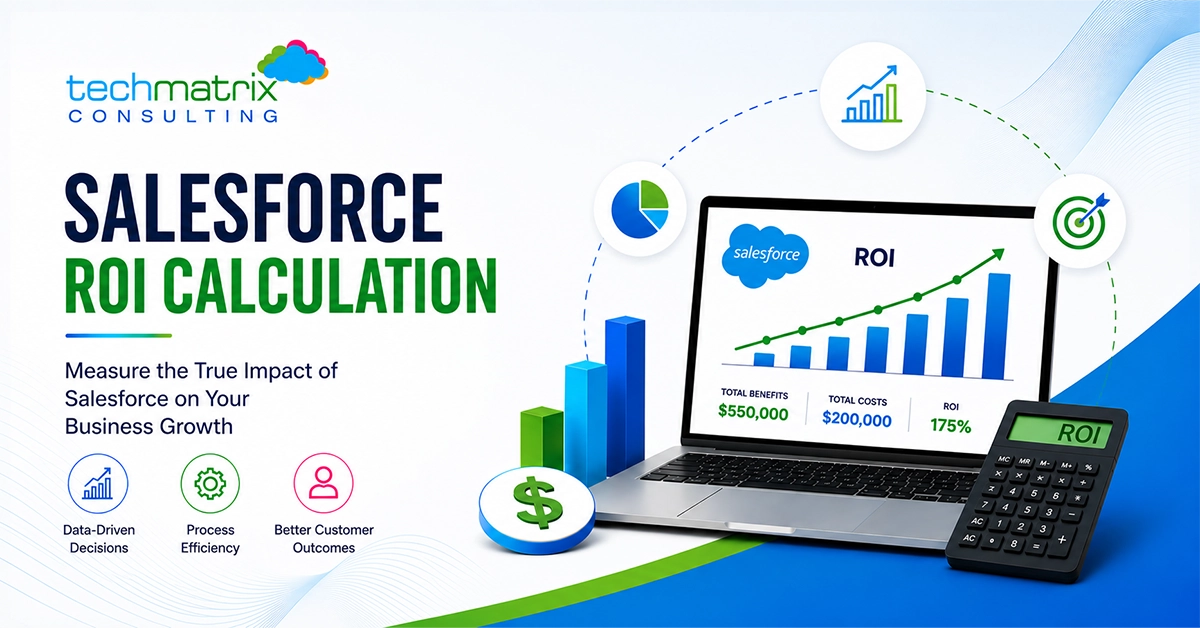
Salesforce ROI % = {(Net Financial Benefits)- (Total Cost of Ownership)/ (Total Cost of Ownership)} x 100
- Calculating Total Cost of Ownership (TCO)
TCO extends far beyond subscription licensing:
- Licensing and Add-ons: Sales Cloud, Service Cloud, Data Cloud, Agentforce credits, and third-party AppExchange subscriptions.
- Implementation and Customization: Initial setup, System Integrator (SI) fees, custom Apex/LWC code development, and middleware integration.
- Ongoing Administration and Governance: Admin/Architect salaries, release management, security compliance, and data governance.
- Data Hygiene and Maintenance: Storage overages, data cleansing tools, and integration pipelines.
- Quantifying Net Financial Benefits
Financial benefits fall into three primary categories:
- Direct Revenue Lift: Incremental deals closed, increased average deal size, and accelerated sales velocity.
- Cost Avoidance and Operational Savings: Reduced support ticket volume, lower call handling times, and diminished need for seasonal headcount expansion.
- Customer Lifetime Value (LTV): Improved retention rates, decreased churn, and expanded account cross-sell opportunities.
The 3 Pillars of Salesforce ROI Calculation
To avoid vague productivity claims, structure your measurement matrix around three core pillars:
ROI Pillar | Primary Metrics | Business Impact |
1. Revenue Growth | • Win rate expansion (%) • Sales cycle length (Days) • Pipeline conversion rate (%) | Drives top-line revenue expansion and increases revenue per sales rep. |
2. Operational Efficiency | • Cost per case resolved ($) • Average Handle Time (AHT) • Automated lead contact rate | Reduces cost-to-serve and frees up capacity for higher-value tasks. |
3. Retention and LTV | • Customer Churn Rate (%) • Net Promoter Score (NPS / CSAT) • Net Retention Rate (NRR) | Maximizes Customer Lifetime Value and protects recurring revenue streams. |
Checklist to Measure Salesforce CRM ROI
Another simpler way to assess qualitatively if your Salesforce is giving you enough CRM ROI is answering these questions:
- Is there automation of manual efforts?
- Is my team able to do accomplish reporting accuracy within the CRM, using the CRM?
- Is data self-cleansing?
- Are we getting accurate AI recommendations?
- Is my CRM able to forecast sales, service, or marketing trends?
- Am I and is my team able to map user behavior and engagement metrics?
- Are all features being utilized, and are there features we can do away with?
- Do the CRM dashboards assist with benchmarking and goal tracking?
If you can figure out answers to these questions or know that you will have positive answers in the future, you are on the right track with your Salesforce system. Remember at times, Salesforce ROI calculation should also ascertain outcomes over just logs or activities. Like, measuring if your team really uses the CRM and achieves productivity gains, rather than computing logins, no. of dashboards created or workstreams completed.
Now, the big question at hand: If Salesforce offers substantial capabilities, why do two-out-of-three enterprise AI and CRM deployments fail to achieve target ROI? Research reveals three critical bottlenecks:
- The Data Fragmentation Wall: Only 26% of enterprise customer data resides natively within Salesforce. The remaining 74% live in disconnected ERPs, mainframes, and external databases. AI agents and sales reps operating without full data context make inaccurate decisions, eroding value.
- Poor Data Quality: 84% of technical leaders state that their data strategies require a complete overhaul before AI and CRM investments can deliver expected business value.
- Governance and Scaling Gaps: Many organizations deploy autonomous tools or complex custom flows without baseline performance tracking or governance framework line-items. As a result, software usage stagnates after initial onboarding.
We calculated Salesforce CRM ROI, but what does that mean? Our goal was to optimize Salesforce usage and maximize return on investment. How do we achieve that?
Salesforce ROI Maximization Matrix
The Salesforce instance you already paid for is either your best-performing asset or your most expensive spreadsheet. The difference isn’t the license. It’s the matrix.
Every rupee of ROI you’re leaving on the table comes back through exactly two levers. Pull both, and the ceiling disappears.
Salesforce ROI can be accomplished in 2 ways:
- INDIRECT – When internal org-wide CRM adoption happens (advantages include daily/monthly hours saved via automation and clearer customer insights that guide sales/marketing efforts)
- DIRECT – When your Sales/Marketing/Service automation efforts show up in revenue numbers (advantages include profitability realized via better lead management or higher conversion rates)
Let us discuss both these:
- How to improve internal CRM adoption?
Driving widespread CRM usage across an organization relies on embedding the platform directly into daily habits while minimizing operational friction. Here is a refreshed strategy to maximize platform engagement:
- Architect a Segmented Rollout Strategy: Avoid a one-size-fits-all deployment. Tailor your onboarding paths and milestones to match specific department goals, ensuring every team sees immediate, personalized value relevant to their core responsibilities.
- Tailor the User Interface and Automate Routine Work: Eliminate tedious manual input by setting up role-specific dashboards, automated task triggers, and pre-configured reporting views. When the system proactively surfaces actionable intelligence, employees view it as an asset rather than administrative overhead.
- Enable On-the-Go Productivity: Modern workflows require flexibility. Deploy mobile CRM capabilities so team members can update records, access client data, and log interactions from any device, anywhere in the field.
- Identify and Leverage Internal Champions: Empower tech-savvy power users within each department to serve as peer mentors. Having on-the-ground advocates speeds up troubleshooting and encourages hesitant team members to embrace new features.
- Gamify and Measure Engagement Metrics: Track key usage indicators (such as login frequency, record updates, and pipeline accuracy) and reward top adopters. Healthy competition combined with clear data visibility keeps platform adoption top-of-mind.
- How to ensure CRM ROI – with your Sales/Marketing/Service automation efforts showing up in revenue numbers?
The average salesperson still spends 13 hours a week on admin, like data entry, updates, and chasing information that should already be there. Every one of those hours is a tax on your ROI. Automate it away and the math flips fast.
When sales teams spend more time selling, marketing teams engage prospects with greater precision, and service teams resolve issues faster, automation begins to show up where it matters most:
More pipeline. Higher conversion. Faster deal cycles. Greater customer value. Stronger revenue growth.
The key is to connect every automation initiative to a measurable commercial outcome. Track how automation impacts:
- Selling time and sales productivity
- Lead response and conversion rates
- Pipeline velocity and deal progression
- Campaign performance and marketing-attributed revenue
- Customer retention, renewal, and upsell opportunities
- Service efficiency and customer lifetime value
CRM ROI is not measured by how many workflows you automate. It is measured by how effectively those workflows improve revenue performance, reduce operational costs, and help teams create more value.
Automate the work that slows your teams down. Measure the outcomes that move revenue up.
Your Salesforce investment should be a revenue engine, not just an expensive address book. If your Sales, Marketing, and Service automation efforts aren’t directly driving top-line growth, you have an execution gap.
To turn system engagement into hard ROI:
- Unify the Ecosystem: Connect Marketing, Sales, and Service Clouds natively. Siloed data kills cross-selling and fractures the customer’s journey.
- Deploy Agentic AI: Move beyond basic triggers. Leverage autonomous agents to score leads, recommend next-best actions, and resolve service bottlenecks instantly.
- Measure What Pays: Abandon vanity metrics. Tie your automation directly to lead-to-close velocity, pipeline value, and customer churn reduction.
Maximize Your Salesforce ROI in 2026 and Beyond: Strategic Blueprint for Enterprise Growth
- Eliminate Data Silos to Power Agentic AI
The leading barrier to adopting advanced agentic AI in Salesforce is poor data availability and quality (53%). Research shows that 74% of enterprise customer data resides outside of Salesforce – trapped in ERPs, legacy mainframes, billing tools, and external databases. When autonomous AI agents lack access to complete customer context, they operate “blind”.
The ROI Fix: Establish unified data architectures using MuleSoft or Data Cloud.
The Business Impact: Forrester research documented in the Integrate.io Salesforce ROI Analysis shows that optimized API integration via MuleSoft delivers a 445% ROI, while automated integration reduces data entry errors by up to 80%. Enterprise leaders who break down data silos report 60% greater efficiency and double the pipeline expansion.
- Transition from Reactive Customization to Autonomous Workflows
Legacy automation tools (such as Process Builder and Workflow Rules) are retired. Leaving legacy automations active causes performance bottlenecks, race conditions, and unmaintained custom code.
The ROI Fix: Audit your org to consolidate legacy processes into single, clean Salesforce Flows. Once core workflows are clean, upgrade from basic email/task automations to Agentforce (Agentic AI). Assign every AI use case with a specific “job description” tied to risk-adjusted ROI metrics.
The Business Impact: High-performing organizations deflecting routine service requests through AI agents free up human representatives for complex, high-value account management, raising average order values by up to 35%.
- Prune Technical Debt and Clean Up Custom Objects
Over-customization kills CRM agility. Cluttered screens with dozens of unused custom fields frustrate users, slow down page loading, and corrupt data quality.
The ROI Fix: Enforce an “every field earns its place” rule. Run regular quarterly audits to deprecate unused custom objects, redundant validation rules, and orphaned picklists.
The Business Impact: Streamlined org architecture improves system response speeds and reduces administrative overhead costs, ensuring your platform scales without exponential maintenance costs.
Get to the doing with not just any other CRM vendor, but one that leads with ROI mindset.
Close the gap between what Salesforce can return and what your org is actually seeing
TechMatrix Consulting connects what you already own (Salesforce, ERP, data, AI) to what’s coming next, without a rip-and-replace and without another vendor to manage. With 500+ Salesforce implementations, 660+ projects delivered, and 550+ customers globally, we help enterprises get more out of Salesforce, from Agentforce AI integration to ERP and data unification – without losing the value already built into your existing CRM investment. If ROI has stalled, that’s usually an implementation and adoption story, not a platform one, and it’s exactly where we come in.
To round up our discussion, we have a few FAQs that will clear the remaining air!
The computation of cost of Salesforce investment vs value it reaps in terms of business efficiency + profitability.
Only when you know the ROI of CRM system implementation can you opt for future optimization and consider adding a strategic AI layer on top of it.
Computing CRM ROI is complex and can be done internally or via a vendor. The time and cost depend on the complexity of CRM installation, licenses, cloud, industry, and market conditions.
When it is optimum, you choose the best, i.e. Summit (pun intended). On a serious note, Salesforce ROI can be maximized with partners that have more experience in not just Salesforce CRM setups, but also governance, enablement and strategic advisory. TechMatrix Consulting is passionate about Salesforce and helping our customers derive maximum Salesforce ROI. Consult with our team for a no-obligation assessment on where your organization is and what it will take to thrive with peak CRM ROI!